-
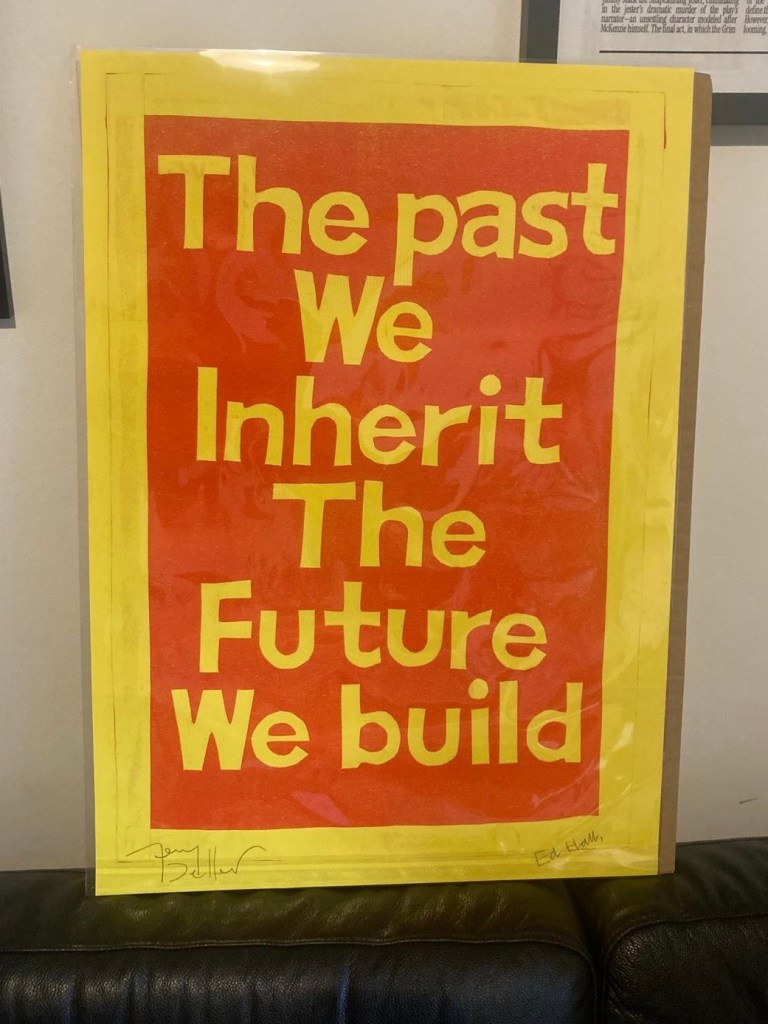
This is the motto of the National Union of Mineworkers. The Durham Miners Gala this year commissioned artist Jeremy Deller and renowned banner maker Ed Hall to create a Riso print edition responding to this theme.
I bought this print as both as a personal celebration for getting my PhD research funded, an achievement that felt so far removed from possibility a few years ago, but also as a reminder. The sentiment and the context feel inextricably connected to what, and how, I want to conduct my research, and what I want it to contribute to.
Firstly, it’s connection to community-based culture, celebration and activism. The Durham Miner’s Gala been going since 1871, celebrating trade union collectivism, community spirit, and international solidarity. This is an example of an ever-expanding gala day, evident in its artistic collaborations and drawing major crowds. Not all gala days around the country see the same fate.
The first Wester Hailes Carnival and Gala Day took place in 1978, a few years after the first flats in the schemes were occupied. It’s hard to know when this stopped (hence further research needed), but from my experience, nothing has replaced these celebrations at the same scale. Wester Hailes is interesting as their history is relatively new- there is not centuries of tradition and connection to place. Yet, there is a long history of the community’s collective action; the year before the first Carnival, the Sentinel community-run newspaper launched, plans for community workshops were underway, the Venchie adventure playground had begun to be built by residents, and an allotment association had been established, all by the new residents (‘Across The Years’, 2010).
Community action and gala days are inextricably linked, often taking place in working towns and areas. On the other side of the city The Craigmillar Festival Society was born out of the same drive to improve social conditions through artistic engagement and protest. Where there are still strong legacies in both areas of Edinburgh, the festivals and carnivals no longer take pace. What then, is the current relationship between community activism and the arts? And what can the past we have inherited inform the present and the future?
“The Slow Cancellation of the Future.”
Over the summer, I read Mark Fisher’s book Ghosts of my Life, where he interrogates a slow cancellation of the future under neoliberalism since the late 1970s. He illustrates this with the example of ‘futuristic’ music long ceasing “to refer to any future we expect to be different; it has become an established style, much like a particular typographical font” (Fisher, 2022, p. 9). For instance, we still think of Kraftwerk, who started experimenting with synthesisers in the early 1970s. Play a contemporary artist like Adele or the Arctic Monkeys to someone in the 1960’s, it wouldn’t seem out of place, whereas play a 1993 jungle record to someone in 1989 and it would be a whole new sound. (Fisher, 2022, pp. 10–11)Where 20th century culture was experimental and ever-changing, time has slowed down, and we are in a grip of a formal nostalgia; ‘a formal attachment to the techniques and formulas of the past, a consequence of retreat from the modernist challenge of innovating cultural forms adequate to contemporary experiences” (Fisher, 2022, pp. 8, 11–12).
This nostalgia mode is symptomatic of what Fisher calls ‘Capitalist Realism’; ‘the widespread belief that there is no alternative to capitalism’ (Fisher, 2022, p. 19). “The slow cancellation of the future is so apt because it captures the gradual yet relentless way in which the future has been eroded over the last 30 years’ (Fisher, 2022, pp. 13–14). He argues that the reinforcement of the neoliberal programme, through globalisation, computerisation and casualisation of labour, partnered with the way technology ‘alters the texture of everyday experience’, has contributed to culture losing its ‘ability to grasp and articulate the present.’ (Fisher, 2022, pp. 8–9). Although writing in 2013, you could add social media algorithms, artificial intelligence, and complete saturation of content and culture to that list. It would seem the challenge to grasp the present only seems harder yet.
Fisher sets out two ways that neoliberal post-Fordist capitalism leads to a culture of retrospection and pastiche; overconsumption and easy access to media, and the systematic deprivation of artists to produce the new (Fisher, 2022, p. 15). Exhausted and over stimulated, nostalgia offers quick and easy familiar satisfactions. That, coupled with inflation of rent and mortgages, closure of arts and third spaces, a shrinking welfare state, higher education costs, and ‘the subsequent ideological and practical attack on public services meant that one of the spaces where artists could be sheltered from the pressure to produce something that was immediately successful were severely circumscribed’ (Fisher, 2022, p. 15) So, people with less time and resource, made things that resembled other things. This was safe, easier to finance, and likely more profitable.
On reading Fisher at the beginning of this research process, I want to hold the following things in mind throughout in relation to cultural outputs, both in a community setting but also across the city. First, how a ‘slow cancellation of the future’ might have affected Wester Hailes and other parts of Edinburgh. Birthed just before a neoliberal Britain via post-war housing developments, how might this a temporal disjunction, described by Fisher, affect what was a new way of living in Wester Hailes? And how might it have affected its cultural output and relationship with the arts, with celebration? Second, how has this impacted the cultural landscape of Edinburgh as a whole, taking into consideration the city centre festivals growing ever larger and profitable (this year there were 4,456 shows over August) (Edinburgh Fringe 2026 by the Numbers, 2026).
Third, it’s important to interrogate the role that nostalgia can play in our present politics. Looking back at cherished celebrations and memories, to community action and output, it’s easy to want to retreat into the past. Not only, as covered by Fisher above, because of the security of familiarity. Nostalgia is an antidote to the new, a powerful emotion that mixes sweetness and loss. This is being increasingly instrumentalised by far-right narratives – put simply, think Reform, Restore, and MAGA. Nostalgia is an emotion I expect to encounter through archival research and community participation and further thought on how I approach this will be needed.
Spectres of Lost Futures and moving forward.
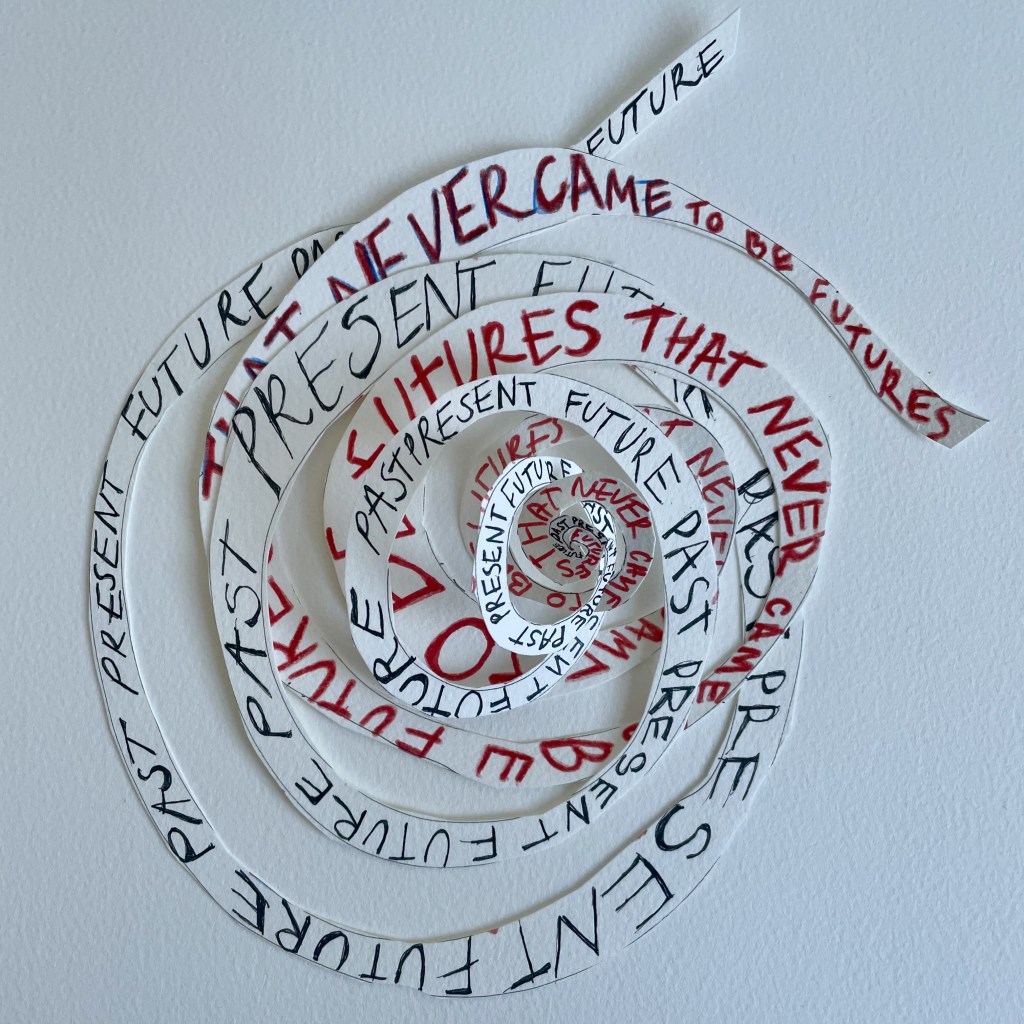
Fisher utilises hauntology, the idea of a spectre of something that is present or influences without existing. First coined by Jacques Derrida in Spectres of Marx, Fisher employs hauntology to think about this temporal disjunction in our culture, arguing that we are haunted by the presence of the lost futures of modernity, cancelled by a neoliberal capitalism. ‘What should haunt us is not the no longer of existing social democracy, but the not yet of the futures that popular modernism trained us to expect, but which never materialised. These spectres – the spectres of lost futures – reproach the formal nostalgia of the capitalist realist world’ (Fisher, 2022, p27).
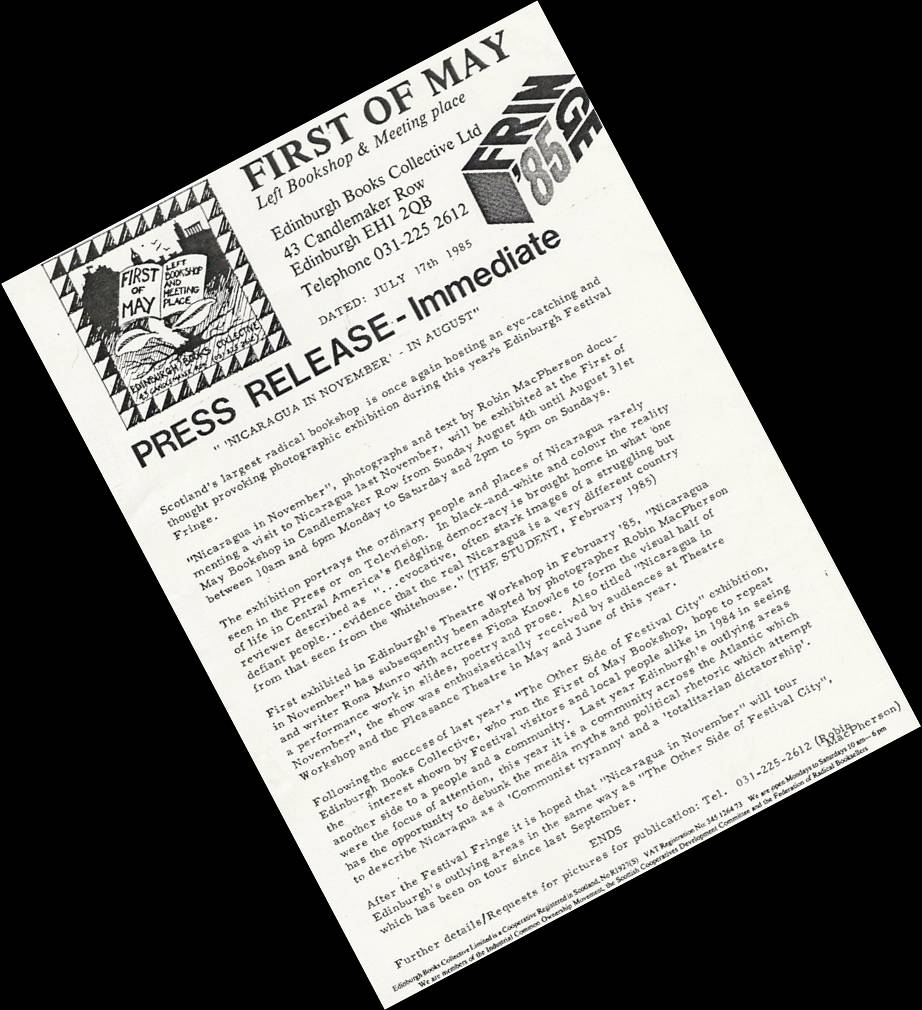
Archives are full of ghosts; of people, of campaigns fought, groups formed, celebrations and festivals. The idea though of the spectre of lost futures particularly resonated with me. Returning to the motto of the miners, we don’t just inherit a past, but the hopes of futures that never were. If we are going to imagine alternative cultural futures, will these be any different from the ones that haunt us now? How do we interrogate these? Can we stop repeating the past? After I’d titled my PhD research, The Other Side of the Festival City, I came across a 1985 press release from the radical bookshop First of May, discussing an exhibition by the same name, focusing on Edinburgh’s ‘outlying areas’. So, I embark upon this new chapter of my life, the beginning of my research, haunted by the ghosts of those who have already been and the futures they imagined, hoping to create something new, with the miner’s motto hanging above my tv.
‘Across The Years’ (2010) From There… To Here, 29 July. Available at: https://hailesmatters.wordpress.com/across-the-years-a-time-line-for-wester-hailes/ (Accessed: 14 October 2026).
‘altedinburgh: Image’ (no date). Available at: https://altedinburgh.wordpress.com/wp-content/uploads/2009/10/first-of-may-21.jpg (Accessed: 14 October 2026).
Edinburgh Fringe 2026 by the Numbers (no date). Available at: https://edfringemap.com/fringe-by-numbers (Accessed: 14 October 2026).
Fisher, M. (2022) Ghosts of my Life. 2nd edn. Zero Books.


